

What is a verge and why does it fail?
So, What is a Verge and Why Does it Fail?
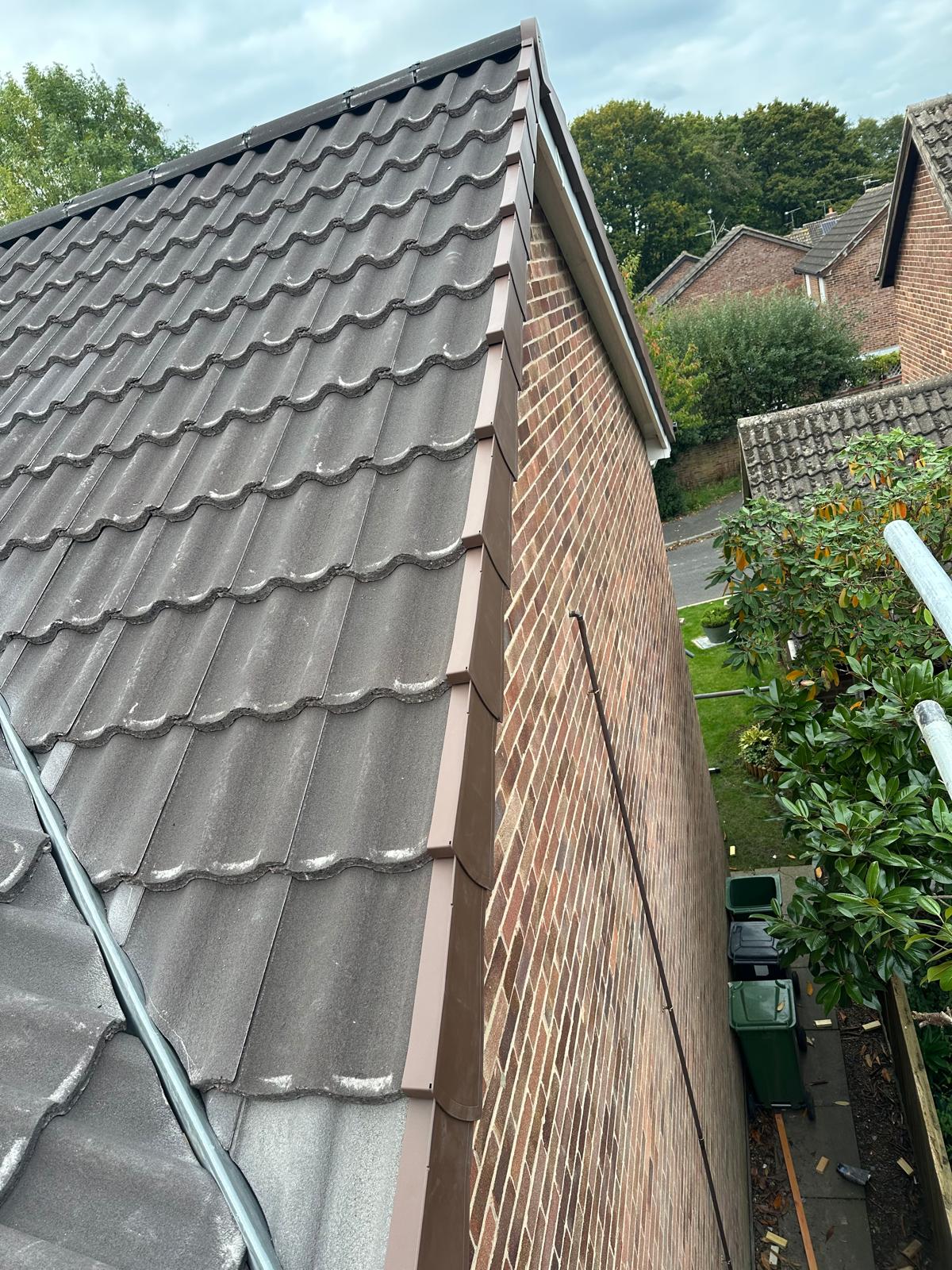
A verge is the edge of your roof at a gable end, the sloping run where the tiles or slates overhang the gable wall and finish, going from the eaves up to the ridge. Every gable-ended house has two of them, one on each side. Their job is to close off and weatherproof the exposed edge of the roof covering, stopping wind from getting underneath the tiles and stopping rain from running down into the top of the wall. It is a small detail in the scheme of a whole roof, but it is one of the hardest working parts of it.
Verges fail mainly because the traditional way of finishing them relies on mortar, and mortar is rigid while a roof is not. Timber moves with heat and moisture, tiles expand and contract, and over years that movement cracks the mortar bed. Once it cracks, water gets in, frost widens the gap, and lumps of mortar begin to fall away and take the edge tiles with them. Add the wind loading that gable edges take, which is higher than anywhere else on the roof, and it becomes clear why the verge is one of the parts we are called out to most. Below is what the verge actually consists of, why it goes, what the warning signs look like, and what your options are when it does.
What the verge is made up of
Look at a gable end and you are usually seeing three things working together. The edge tiles or slates overhang the wall by a small margin so water drips clear rather than running down the brickwork. Beneath them sits an undercloak, a strip of fibre cement board or plain tiles laid along the top of the gable wall to form a level base and give the mortar something to sit on. On top of that comes the mortar bedding, the visible sloping line of mortar that seals the joint between tile and wall.
Some houses use a bargeboard, a timber or plastic board fixed to the gable to cover and protect the edge, and others use purpose-made cloaked verge tiles that wrap around the corner and need no mortar at all. Whichever form yours takes, the principle is the same. The verge is a seal on an exposed edge, and it is only as good as the material holding it together.
Mortar verges and dry verges
There are broadly two approaches. A wet verge is the traditional one, bedded in mortar. It is what you will find on the vast majority of older properties across West Sussex, and when it is done well with a properly graded sand and cement mix it can last a long time. Its weakness is that it is a rigid seal on a moving structure, so it will eventually crack.
A dry verge is the modern alternative. Interlocking uPVC or aluminium caps are mechanically fixed over the edge tiles, clipped and screwed rather than glued down with mortar. There is nothing to crack, nothing to wash out, and the fixing does not depend on a bond that degrades. Dry verge systems also allow a little ventilation at the roof edge, which mortar does not.
In our experience, converting to a mechanically fixed dry verge system works better than re-bedding a mortar verge on exposed gables near the coast, because the salt-laden wind and driving rain we get across Worthing and Lancing attack the mortar bond faster than they do inland, and a re-bedded verge on a wind-facing gable often starts hairline cracking again within a few years. On a sheltered inland gable in good condition, re-bedding is perfectly reasonable and cheaper. On a west-facing coastal gable, it tends to be money spent twice.
Why verges fail
Verge failure is rarely one dramatic event. It is a slow sequence, and it usually runs like this.
- Thermal and structural movement. The roof expands, contracts and settles. The mortar cannot flex with it, so it develops hairline cracks.
- Freeze-thaw damage. Water enters those cracks, freezes, expands and widens them. This is why winter weather is so often the point at which a verge that looked passable in September starts shedding mortar by February.
- Wind uplift. Gable edges and corners take the highest wind pressures on the whole roof. Once the mortar is compromised, wind gets under the edge tiles and starts lifting them.
- A poor original mix. A mortar that is too rich in cement is brittle and cracks early. A mix that is too weak crumbles. Plenty of verges we see failing at twenty years were compromised on the day they were laid.
- A failed or missing undercloak. If the undercloak has sagged, broken or was never fitted properly, the mortar has nothing solid to sit on and it goes early.
- Vegetation and moss. Moss and weeds root in the cracks and prise them wider every season.
The same rigidity problem affects the other mortar-bedded parts of the roof, which is why ridge pointing tends to fail on a similar timescale and is worth checking whenever a verge is being assessed.
The warning signs to look for
Most of this is visible from the ground with a decent pair of binoculars. Look for gaps or hairline cracks running along the mortar line at the gable. Look for pieces of mortar on the ground or in the border beneath the gable, which is often the first thing a homeowner notices. Look for edge tiles sitting unevenly, lifted or slipped out of line. Look for green growth in the mortar joint. Inside, look for damp patches on the upstairs walls near the gable, or daylight visible in the loft along the edge of the roof.
A failing verge is also a safety issue. Mortar and edge tiles falling from a gable land on paths, drives and cars, so it is not a fault to leave sitting through a windy winter.
What to do about a failing verge
If the mortar has only just started to craze and the tiles are sound, re-bedding the verge with a correctly graded mix is a straightforward job. If mortar is falling away in sections, if edge tiles have moved, or if the undercloak has gone, the verge needs stripping back and rebuilding properly, and that is the natural point at which to consider a dry verge system instead.
Worth knowing is that the British Standard covering slating and tiling, BS 5534, was revised so that ridge, hip and verge tiles must now be mechanically fixed rather than relying on mortar alone to hold them. A verge bedded purely in mortar with no mechanical fixing reflects an older approach, which is a reasonable prompt to bring it up to current practice when the work is being done anyway. Any competent roofer working to the standards set by bodies such as the NFRC will fix the tiles as well as bed them.
Verge work sits alongside the rest of the roof edge, so it is often sensible to sort the verge, the ridge and any moss at the same time rather than paying for access twice. Most verge work falls under general roof repair, though on a tiled roof or slate roof that is already near the end of its life, it is worth asking whether the verge is a symptom rather than the problem.
Getting a verge looked at properly
A verge is easy to ignore because it is not leaking yet, and expensive to ignore because by the time it is leaking, the wall beneath it usually is too. If you can see mortar coming away from your gable, that is the point to have it assessed rather than waiting to see how it comes through the next storm.
With over 20 years working on gable ends across Worthing, Lancing and the wider West Sussex area, fully insured and vetted through Approved Roofers, the Roofing Register and Checkatrade, rated roofers will tell you honestly whether a verge needs re-bedding, replacing or simply leaving alone for now. Get in touch for a free, no-obligation quote and we will take a proper look.



Comment (0)