

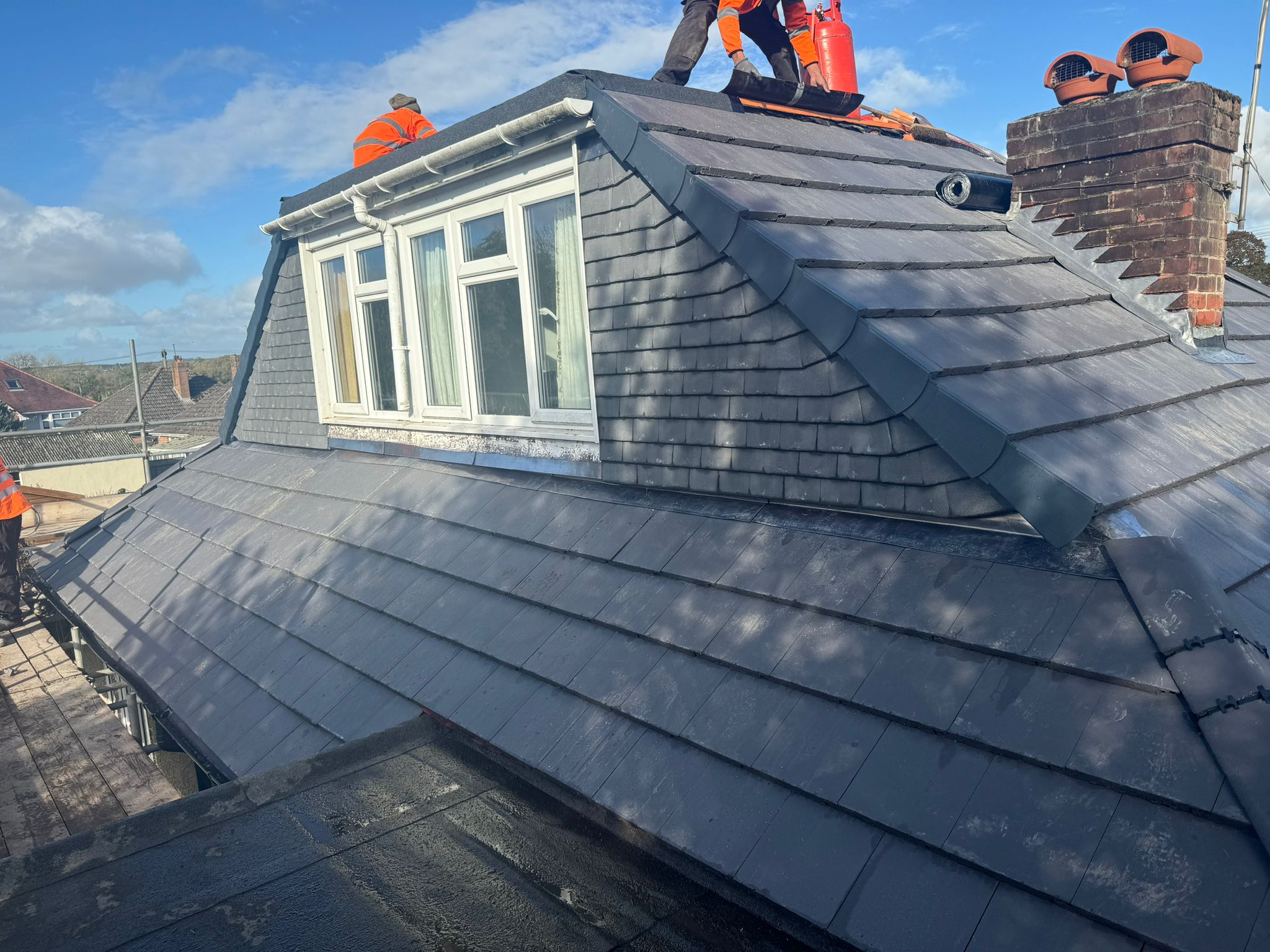
Flat Roof Repairs Eastbourne
If you need flat roof repairs in Eastbourne, we cover it. Rated Roofers repair flat roofs across Eastbourne and the surrounding area, from leaks and splits to blistering, failed seams, ponding water and worn flashing at the upstands. Most flat roof faults are straightforward to diagnose once someone has been up to look, and caught early they are usually a repair rather than a full replacement. If you have water coming through a ceiling below a flat roof, a visible split or blister in the covering, or pools of water still sitting up there a day after rain, that is the point to get it assessed.
Eastbourne is a harder place to keep a flat roof watertight than most, and it is worth understanding why before deciding what to do. The town sits right on the coast at the eastern end of the South Downs, so its flat roofs take salt-laden wind and sea exposure, and it is also one of the sunniest towns in the UK, with close to 1,900 hours of sunshine a year, nearly 500 hours above the national average. That combination of strong sun and coastal wind is exactly what breaks flat roof coverings down fastest. Add the large number of flat-roofed extensions, garages, dormers and seafront properties across the town, and flat roof repair is one of the jobs that comes up most here. The rest of this guide explains the faults we see most often, why the local climate drives them, and how to decide between a repair and a re-cover.
The most common flat roof faults we repair
Flat roofs fail in a handful of recognisable ways, and the fix depends on which you have.
- Splits and cracks in the covering. Usually the result of age and sun exposure, where the covering has lost its flexibility and cracked. This is the classic end-of-life failure, particularly in felt.
- Blistering. Bubbles form where moisture or air has become trapped beneath the covering. Left alone they grow, then split and let water in.
- Failed seams and laps. The joints between sheets, and the upstands where the roof meets a wall, are where a large share of leaks begin, because they are the weakest points in an otherwise sound covering.
- Ponding water. A flat roof should never be truly flat. It needs a slight fall so water drains. When the fall is inadequate or the deck beneath has sagged, water sits, and standing water finds every weakness and accelerates decay.
- Flashing failure. The seal where a flat roof abuts a wall or chimney fails as the flashing lifts, splits or loses its pointing.
- Deck rot. The most serious. When water has been getting in for a while, the timber or board deck beneath the covering rots and goes soft, which is a repair to the structure rather than just the surface.
Anything beyond a small isolated split is worth an inspection first, because a flat roof leaking in one spot has often been letting water into the deck for some time before it showed indoors. Our general roof repair work starts with finding the true source rather than patching the symptom.
Why Eastbourne is hard on flat roofs
The two things that destroy flat roof coverings are ultraviolet light and standing water, and Eastbourne delivers plenty of the first. Sunshine is not gentle on a roof. UV breaks down the surface of a covering over years, drying it out, making it brittle and eventually cracking it, and a town with close to 1,900 hours of sun a year subjects its flat roofs to more of that than most of the country. Met Office records have long placed Eastbourne among the sunniest spots in the UK, and while that is good news for residents it is hard on their roofs.
Felt suffers worst of all under strong sun, softening and scuffing in summer heat and going brittle over time, which is why understanding how long felt roofs actually last matters so much here. On top of the UV, the coastal wind drives rain hard against upstands and works at any lifted seam, and salt in the air is unkind to older metal fixings and flashings. We’ve found that flat roofs on the exposed seafront side of town reach the end of their life noticeably sooner than equivalent roofs a few streets inland with a little more shelter.
Repair or replace?
The right answer depends on the covering’s age and condition and, just as importantly, on the state of the deck underneath. If the covering is sound and the problem is a single split, a failed seam or a lifted flashing, a targeted repair is the sensible and economical choice. If the covering is old, brittle and failing in several places at once, patching it repeatedly is throwing money at a roof that has reached the end of its life, and a re-cover is better value.
The deciding factor is often the deck. A sound deck with a tired covering is a re-cover. A rotten, soft or sagging deck is a rebuild, because no covering laid over failing timber will last. This is why a proper inspection looks beneath the surface rather than judging the roof by its top layer alone.
Choosing the right covering if you re-cover
If a re-cover is the answer, the covering you choose matters, especially in this climate. It is worth understanding the most common flat roof materials before deciding, because they behave very differently under sun and salt.
In our experience, re-covering a failed Eastbourne flat roof in EPDM rubber or a modern high-performance system works better than laying another layer of mineral felt over the old one, because the town’s high sunshine hours and coastal exposure break felt down faster than inland, so a felt covering that might give decades of service in a sheltered spot has a shorter life here. EPDM in particular handles UV and movement well and carries long manufacturer guarantees. Felt is cheaper at the outset, and on a small, shaded or low-priority roof it can still be a reasonable choice, but on an exposed, sun-baked roof the longer-lasting covering usually works out cheaper over its lifetime. Our flat roof work covers repair and re-cover in whichever material genuinely suits the roof.
Do not ignore a flat roof leak
Flat roof leaks are one of the clearest examples of a problem that gets worse and more expensive the longer it is left. A small split is a quick fix. The same roof after a wet winter, with a saturated deck, rotten timber and water spreading sideways beneath a covering that still looks intact from above, is a far bigger job. In a sunny, exposed coastal town where coverings are already working hard, that decline can be quicker than owners expect.
Rated Roofers are a family-run firm with over 20 years of experience working on flat roofs across Sussex, fully insured and vetted through Approved Roofers, the Roofing Register and Checkatrade. If your flat roof in Eastbourne is leaking or looking tired, rated roofers will assess it honestly and tell you whether it needs a repair or a re-cover. Get in touch for a free, no-obligation quote and we will take a proper look.


Comment (0)