What is a temporary roof repair and how long does it last?
7 min readBy Jacob Francis
On this page (8)
- 01What counts as a temporary roof repair
- 02How long does a temporary roof repair last?
- 03When a temporary repair is the right call
- 04When a temporary repair is the wrong call
- 05Why it is not a job for a ladder
- 06Listed buildings and older homes
- 07Turning a temporary repair into a proper one
- 08Getting a temporary repair done
A temporary roof repair is a quick fix that stops water getting into your home until the roof can be repaired properly. It might be a tarpaulin secured over a damaged slope, a few slipped tiles or slates put back or swapped for spares, a patch over a split in a flat roof, or a lifted flashing dressed back down. There is no fixed lifespan. It lasts as long as the fixing and the weather allow, and it should be treated as days or weeks of protection while the permanent repair is arranged, never as something to see you through a winter.
The point of a temporary repair is to limit the damage, not to cure the cause. Water that gets past the covering soaks the battens, the insulation and the ceiling below, and the cost of that can soon outweigh the original fault. A good temporary repair buys time to have the roof looked at properly, deal with an insurer if there is a claim, and book the right work. A bad one, done in a hurry from a ladder, can make the damage worse and hide it from whoever comes to fix it.
What counts as a temporary roof repair
Most temporary repairs fall into a handful of types, and the right one depends on what has failed.
- A secured tarpaulin. Laid over the damaged area and taken over the ridge where possible so water runs off it rather than under it, then fixed down so the wind cannot get beneath an edge.
- Slipped tiles or slates put back. Using spare or reclaimed pieces of the same type, or holding a slate on a clip, until the area can be relaid properly on tiled roofs or slate roofs.
- A patch on a flat roof. Repair tape, a cold applied sealant or a piece of membrane over a split or a blister in a flat roof, put down when the surface is dry enough for it to bond. How well that holds depends on which of the common flat roof materials it is going onto.
- Flashing dressed back. Lead that has lifted where the roof meets a chimney or a wall pushed back into place and sealed, until it can be refixed. Lead flashing is a common point for water to get in after strong wind.
- A blockage cleared. Sometimes the leak is water backing up rather than a hole, and clearing a gutter or an outlet is the whole fix for now. That is often the answer when gutters overflow even when they look clean.
Each of these keeps water out. None of them deals with why the tiles slipped, the felt split or the lead lifted, which is exactly why they stay temporary.
How long does a temporary roof repair last?
There is no standard figure, and a firm number for how long a tarpaulin or a tub of sealant will hold is a guess. What actually decides it is a handful of things you can see.
- How well it is fixed. A cover with a loose edge gives the wind something to catch, and the next gust can strip it off along with more tiles.
- The weather. Strong wind works at edges and fixings, and sunlight breaks plastic sheeting down over time.
- What it is covering. A small patch over a single split is a very different thing from a sheet over a section with tiles missing.
- Whether the cause is still at work. If slates are slipping because the nails holding them have corroded, more will follow, temporary repair or not.
So treat any temporary repair as short term. Check it from the ground after every spell of strong wind, and book the permanent repair at the same time as the temporary one rather than waiting to see how it holds. If you are claiming on your insurance, tell the insurer the repair is temporary and ask how soon they can assess the damage. The steps for that are set out in how to claim for storm damage on your roof.
When a temporary repair is the right call
A temporary repair is the sensible choice in a few clear situations.
- When a full repair cannot be done safely yet. Nobody should be stripping and relaying a roof in a gale or on a soaking surface. Making it watertight and coming back in calmer weather is the safer order, which is also why it pays to prepare a roof before heavy rain and wind rather than after.
- When you are waiting on an insurer. The Association of British Insurers advises carrying out emergency repairs to prevent further damage only where it is safe, speaking to your insurer first, and keeping photos and an itemised invoice.
- When materials have to be found. Matching an older clay tile or a particular slate can take time, and a roof does not need to stay open while you wait.
- When the permanent job needs access equipment. If the repair needs scaffolding, a temporary fix keeps the house dry while that is arranged.
When a temporary repair is the wrong call
The commonest mistake is letting a temporary repair become the permanent one. A tarpaulin that has been on all winter, or sealant pasted over the same cracked flashing every year, is costing you money each time while the fault underneath carries on. If you are paying for a second or third patch on the same spot, that is the roof telling you it needs a proper repair. Leaving minor roof damage under a patch for too long is how a small job becomes a big one.
Sealant spread over tiles or slates is another trap. It can stop a drip for a while, but it can also make the pieces harder to reuse when the area is relaid, and it hides the crack from whoever comes to inspect it.
And if the roof is near the end of its life, repeated temporary repairs are money that would be better put towards the real decision. Knowing how long a roof lasts in the UK helps you judge whether it is better to repair or replace.
Why it is not a job for a ladder
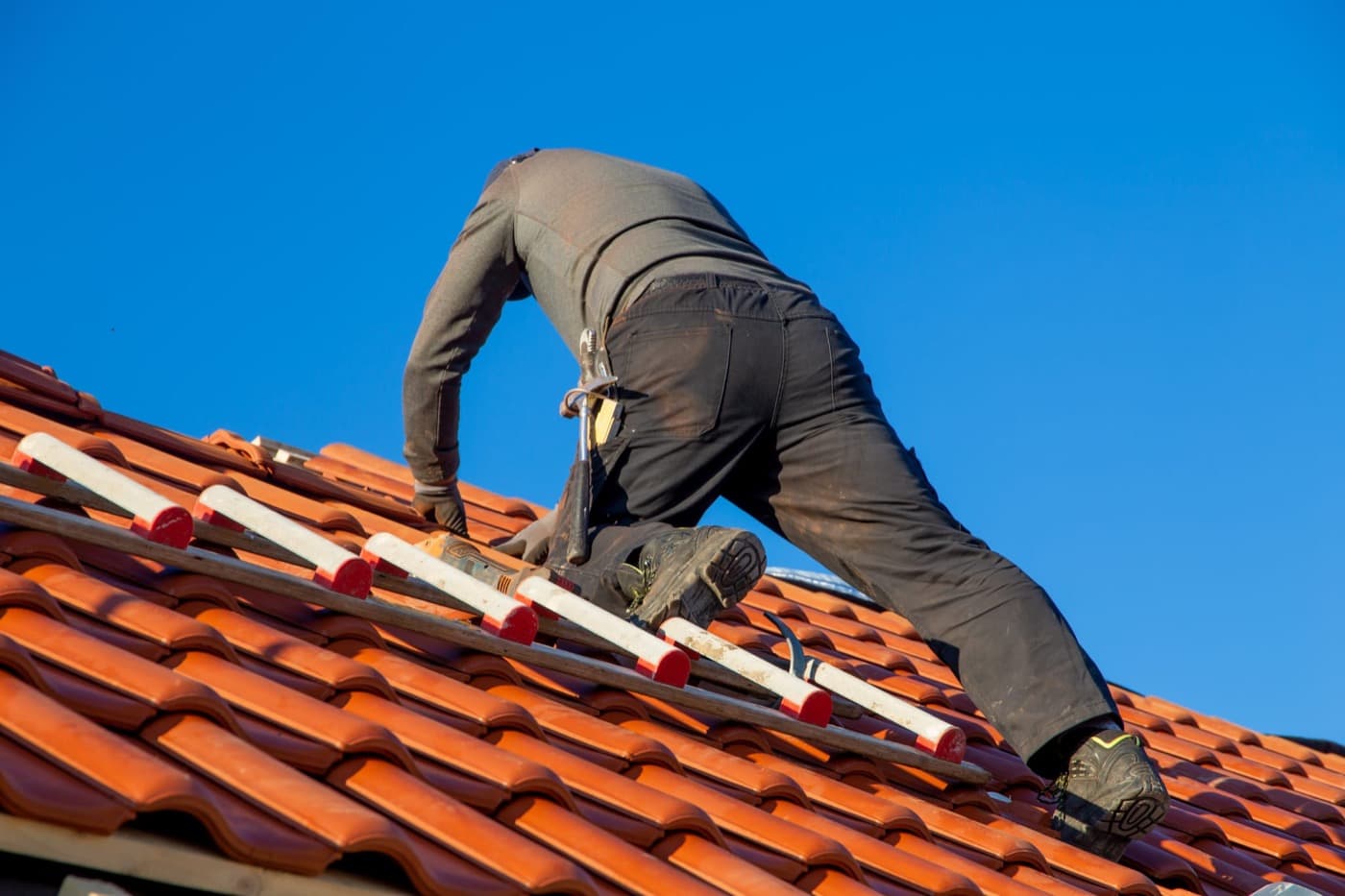
The Health and Safety Executive says almost one in five deaths in construction work involve roof work, and that many deaths each year involve smaller builders working on the roofs of houses. Its guidance is that all roofs should be treated as fragile until a competent person has confirmed they are not, and that edge protection is needed at the eaves. That is guidance for people who work on roofs for a living, which says a lot about the risk to anyone climbing up in a storm to hold a sheet down.
From the ground, the useful things a homeowner can do are to catch the water, move belongings out of the way, keep away from any ceiling that is bulging, and take photos. The same goes for flat roofs, which look solid underfoot but are not always, as anyone wondering whether you can walk on a flat roof soon finds out.
Listed buildings and older homes
Plenty of homes across Sussex are listed, and Lewes in particular has a lot of them. Work that affects the character of a listed building normally needs listed building consent from the council, and that does not go away in an emergency.
The Planning (Listed Buildings and Conservation Areas) Act 1990 only allows a defence for urgent unconsented work where it was urgently necessary for safety, health or the preservation of the building, where temporary support or shelter was not practicable, where the work was kept to the minimum immediately necessary, and where the council was given written notice justifying it as soon as reasonably practicable. In plain terms, a temporary covering that protects the building without altering it is the first step, and anything beyond that needs a conversation with the council's conservation officer. If you live in or near Lewes or Arundel, it is worth knowing before anything happens, and the wider rules on planning permission for roof work apply alongside.
Turning a temporary repair into a proper one
Once the roof is watertight, the next step is finding out why it failed. A slipped tile might be a one off, or one of many held on by corroded nails. A leak at a chimney might be the flashing, the pointing or the stack itself. A proper inspection looks at the area around the temporary repair and the roof as a whole, in the same way a roof survey would, so the permanent work fixes the cause and not just the symptom.
That is also the moment to check the other signs a roof needs repairing, because whatever let the weather in at one point is often at work elsewhere. The usual culprits are covered in common causes of roof leaks in UK homes.
Getting a temporary repair done
A temporary roof repair is there to keep the water out and nothing more. Done properly it protects your home for days or weeks while the real repair is arranged. Left in place too long, or done badly from a ladder, it costs more than it saves.
If your roof is letting water in anywhere in the areas we cover, contact us and we can make it watertight and then carry out the permanent roof repairs. Rated Roofers has over 25 years in the roofing industry and runs a 24 hour emergency call out, and you can also ask for a free quote for the follow-up work.
Need this doing
Roof Repairs
Leaks, slipped tiles and storm damage traced and fixed.