What is chimney flaunching and when does it need replacing?
5 min readBy Jacob Francis
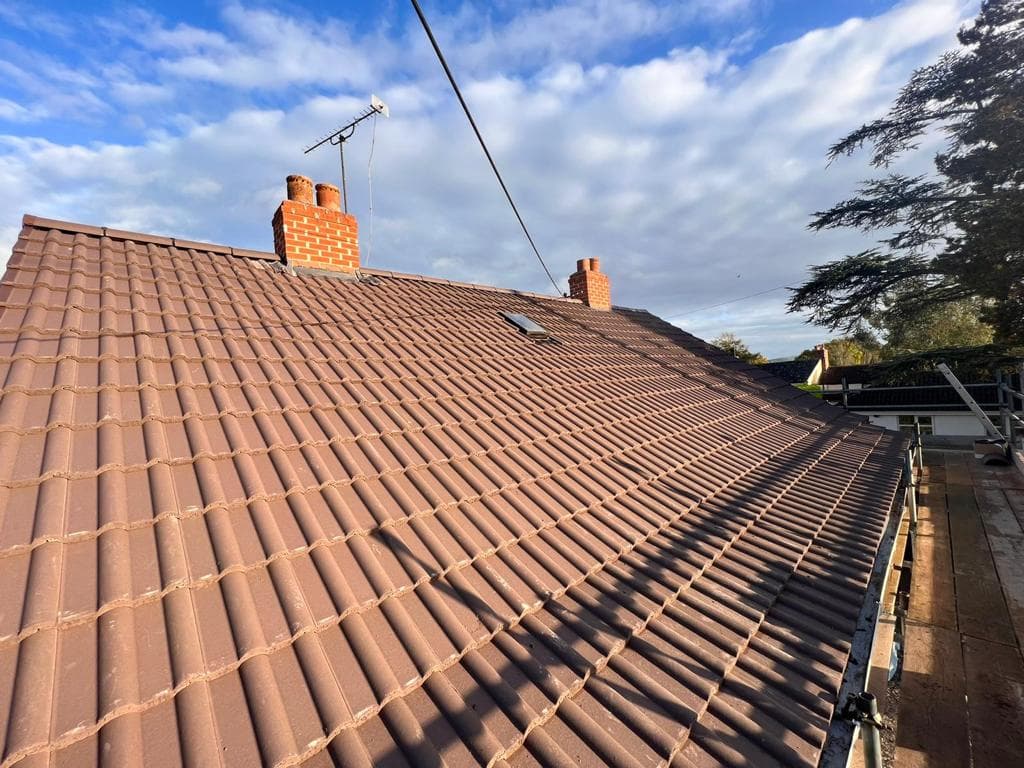
Chimney flaunching is the sloping bed of mortar on top of a chimney stack that holds the pots in place and sheds rainwater off the top of the stack. It needs replacing when it has cracked, crumbled or come away, when a pot has worked loose in it, or when water is getting into the stack from the top. Frost is the usual culprit. The flaunching takes the full force of the weather, so it tends to fail well before the pots or the brickwork beneath it.
Replacing it is normally a straightforward repair, as long as the old mortar comes off without damaging the pots and the new mix suits the chimney. Left alone, failed flaunching lets rain into the stack, loosens the pots and can lead to damp inside the house. It also shows up most in winter, which makes autumn the time to check it.
What flaunching does
On a typical stack, each chimney pot sits over its flue, and the mortar flaunching is built up around the base of the pots and sloped outwards to the edges of the stack. That slope throws rainwater off the top rather than letting it sit there and soak in. It also holds the pots firmly against the wind.
SPAB, the Society for the Protection of Ancient Buildings, describes how this was often built on older chimneys. Pots were commonly supported on iron bars set one or two courses down from the top of the stack, the gap around each pot was covered with slate or tile, and the mortar flaunching went over that. It warns that corroding iron bars can crack the top of a stack and lift the upper courses, and if the bars rust through, a pot can drop. So a problem that looks like failed mortar can sometimes go deeper.
Why flaunching fails
The Building Conservation Directory puts it simply. Flaunching decays more readily than the pots, usually by frost action. Water gets into fine cracks, freezes, expands and opens them up a little further each winter, until pieces come away. A stack is the most exposed part of a house, standing above the roofline in the wind and rain, so its top takes more weathering than any other masonry on the building.
That exposure is sharper in some places than others. On the downs at Lewes, wind driven rain erodes mortar faster than in a sheltered spot, and along the coast at Arundel the salt laden wind off the Channel works mortar loose. The winter weather that affects every roof hits the top of a chimney hardest.
Signs your flaunching needs replacing
Most of these can be seen from the ground, with binoculars if you have them. Do not go up a ladder to look.
- Cracks or missing pieces. Cracks running across the flaunching, or chunks missing from the edges.
- Debris. Bits of mortar in the gutter, on the roof slope below the stack, or on the ground.
- A loose or tilting pot. A pot that has moved, leans, or rocks in high wind has usually lost its grip on the mortar.
- Plants growing on top. Moss or weeds on the flaunching mean water is sitting in it.
- Damp inside. Damp patches on the chimney breast, or in the loft around the stack. SPAB lists the disintegration of flaunching at the top of a chimney among the ways rainwater gets in, and damp from roof problems often shows first around a stack.
- Staining on a flue in use. SPAB notes that condensates or tar seeping through chimney walls is particularly common with wood burning, and is made worse where moisture is getting in, for example through deteriorated flaunching.
If the stack itself is leaning or its brickwork is open and crumbling, that is a bigger job than the flaunching alone, and a leaning chimney stack needs looking at before anything else.
Which mortar should be used?
This is where older chimneys need care. SPAB's advice is to never use strong Portland cement for work on chimneys and fireplaces, and says lime based mixes without cement are normally appropriate on older buildings dating from before about 1919. Traditional mortars allow for expansion, contraction and moisture, which reduces the likelihood of the masonry cracking. SPAB also says loose chimney pots should be re-bedded in lime mortar.
Many chimneys have been flaunched in a hard, cement rich mix at some point. The Building Conservation Directory notes that replacing flaunching is a simple matter, but that care is needed not to damage the pots when cleaning off old hard cement flaunching, and that where some cement has to be added to a mix, sulphate resisting cement should be used. On a newer house, a sand and cement flaunching is normal. On a Victorian or older stack, the mortar should suit the bricks and the pots, and a roofer should be able to explain which they are using and why.
Pots, caps and liners while you are up there
Replacing flaunching is a good moment to deal with the rest of the stack top.
- Cracked or broken pots. SPAB says cracked pots on flues in use should be replaced. The Building Conservation Directory says the only practical answer for a broken pot is a facsimile replacement, and that designs can be made to match originals.
- Redundant flues. The Building Conservation Directory notes that a fairly discreet capping can stop rain coming down a flue, with types for flues that are no longer used, which still need ventilation, and for flues in use, where a cap can affect the draught.
- Relined flues. Where a flue has been relined and no pot is fitted, SPAB says at least 100mm of liner should be left projecting above the flaunching, to help the draw and to stop rain or snow being blown across the flaunching into the flue.
- Nests. Gulls and other birds build on and in chimney stacks. If seagulls have been nesting on the roof, clear the old material once the nest is no longer in use.
- The leadwork. The flashing where the stack meets the roof often needs attention at the same time, and the difference between Code 4 and Code 5 lead matters if it is being replaced.
Listed buildings
On a listed building, SPAB advises that listed building consent may be required for work to an old chimney that goes beyond like for like repair, and that it is a criminal offence to carry out work needing consent without it. Replacing a few bricks like for like is a repair, while taking down and rebuilding an old chimney requires consent. If you are unsure, the council's conservation officer is the person to ask before work starts. Lewes in particular has a great many listed buildings.
Is it covered by insurance?
Flaunching that has broken down through years of frost is wear, and home insurance does not normally pay for wear. A pot or a section of stack brought down in a storm is a different matter, and whether you can claim for a new roof on your home insurance, or only for the part that was damaged, depends on what the storm actually did. If a storm has left the top of a stack open, a temporary roof repair keeps the weather out while the proper job is arranged.
Getting your flaunching checked
Flaunching is the mortar cap that holds the pots and keeps rain off the top of a chimney, and frost is what usually breaks it down. Cracks, debris, a loose pot or damp around the chimney breast are the signs it needs replacing. On an older stack, the right mortar matters as much as the repair.
If your chimney needs looking at anywhere in the areas we cover, contact us and we can inspect the stack and carry out the chimney repairs it needs. Rated Roofers has over 25 years in the roofing industry, and you can also ask for a free quote.
Need this doing
Chimney Repairs
Repointing, flaunching, lead flashing and full rebuilds.